
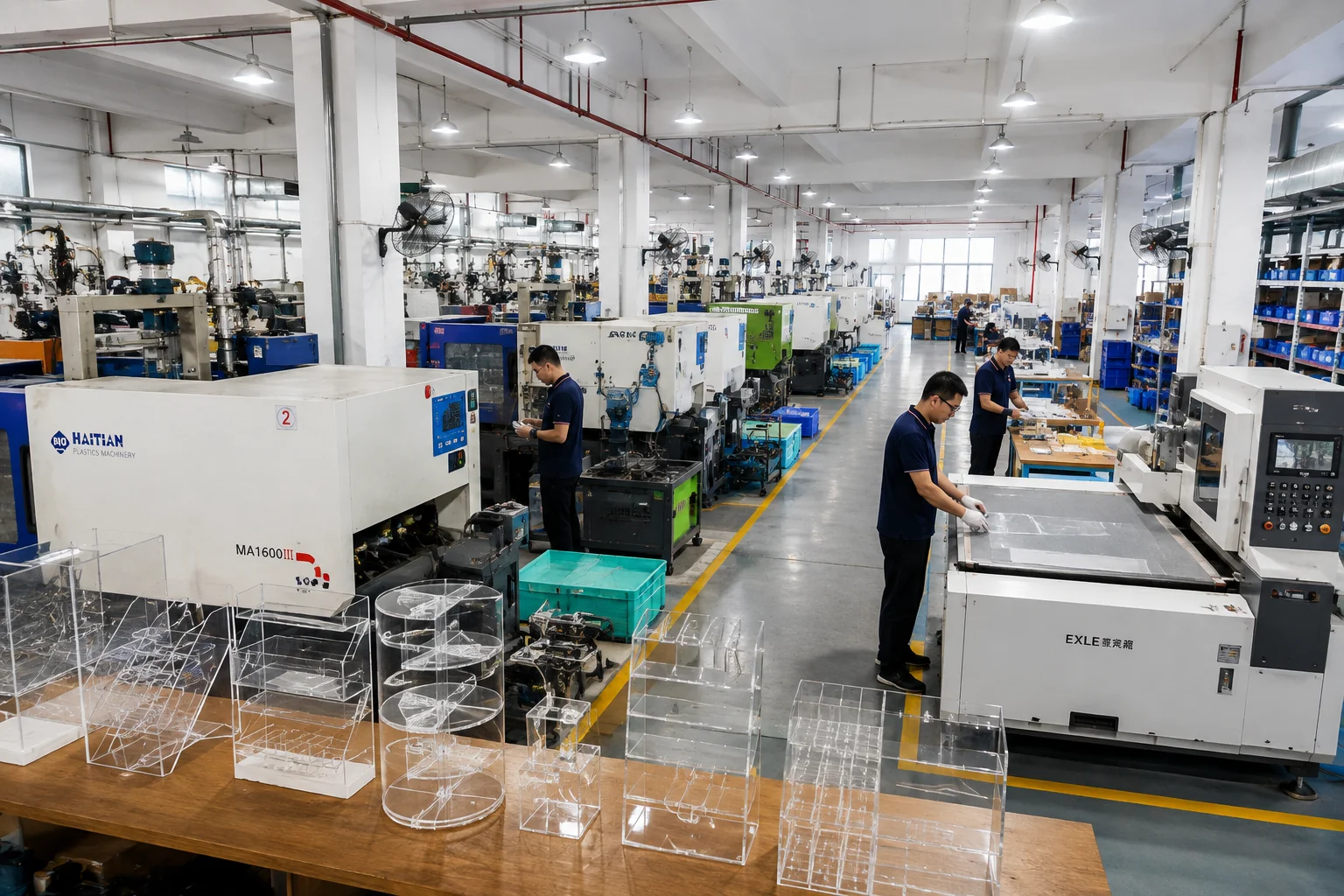
Why does the edge matter more than the face?
The face is flat and uniform, so it hides small differences. The edge is where light enters the material, and any saw mark, sanding scratch or heat haze shows up as a bright line. Two displays made from the same sheet can look like different grades of product purely because of how the edge was treated.
What are the four finishes you will be offered?
They run from cheapest and roughest to most expensive and clearest. The trade-off is appearance against labour time, not material.
- Saw-cut - the raw edge straight off the blade. Matte, with visible tool marks. Used where the edge is hidden by a frame, a slot or the base.
- Sanded - mechanically smoothed to a uniform matte. Removes saw marks without producing a glass-like shine; common where a soft satin edge suits the design.
- Flame-polished - passed against a heat source so the surface melts briefly and flows. Produces a clear, glossy edge quickly and is the usual finish for clear retail displays.
- Diamond-polished - machined and then progressively polished to a high-clarity, optically flat edge. The clearest result and the most labour-intensive one.
Which finish suits which merchandise?
Match the finish to how close the customer gets and what the display is holding. High-clarity edges belong on premium jewellery and fragrance; a soft matte edge can read as more restrained next to brushed metal; hidden edges do not need polishing at all. Specifying a diamond-polished edge on a part that sits inside a slot is paying for something nobody will see. See acrylic jewelry display stands.
How do you judge a finish on a sample?
Look along the edge rather than straight at it, in daylight rather than under a single lamp. Check for haze, waves, scorch marks and rounded corners where the edge should be crisp. Then compare it against the same edge on a second part of the same sample: consistent finish across parts matters more than one perfect edge. See the OEM and ODM process.
What should the brief say about edges?
Name the finish, say which edges it applies to, and state what the corners should look like. Where an edge is hidden in the assembly, say so, because that is where a supplier can reduce cost without changing the result. A drawing that leaves the finish unspecified will be quoted at whichever finish is cheapest to run.
How this buyer content is maintained
Published and reviewed by Yiwu Zhuochao Plastic Products Co., Ltd. Company facts are checked against the assessed Alibaba supplier profile; product and process guidance is based on the supplier’s current manufacturing scope and project-review workflow. Commercial terms and performance statements are published only where the owner can support them. Third-party certification issued by Intertek (天祥集团) is documented on the certification page; unit prices are quoted per project and are not published.
Frequently asked questions
Can flame polishing leave marks or crazing?
It can. Too much heat or uneven travel produces haze, waves or fine surface crazing, and thin sheet is less forgiving than thick. This is a process-control issue, which is why the finish should be approved on a sample rather than assumed from a description.
Does a polished edge scratch more easily?
A polished edge shows scratches more readily than a matte one because it reflects light uniformly. The material is not weaker, but damage is more visible, which matters on parts that are handled during assembly or shipping.
Does the edge finish change lead time?
It can, because polishing is hand time rather than machine time, and a high-clarity finish on many parts adds work to the run. Ask for the finish to be quoted as a line item so its effect on schedule and cost is visible rather than buried in the unit price.
Can edges be left raw to reduce cost?
Yes, and on internal or hidden edges that is often correct. On any edge the end customer can see, a raw saw-cut edge usually reads as unfinished. Decide edge by edge, not per display, and record the decision on the drawing.