
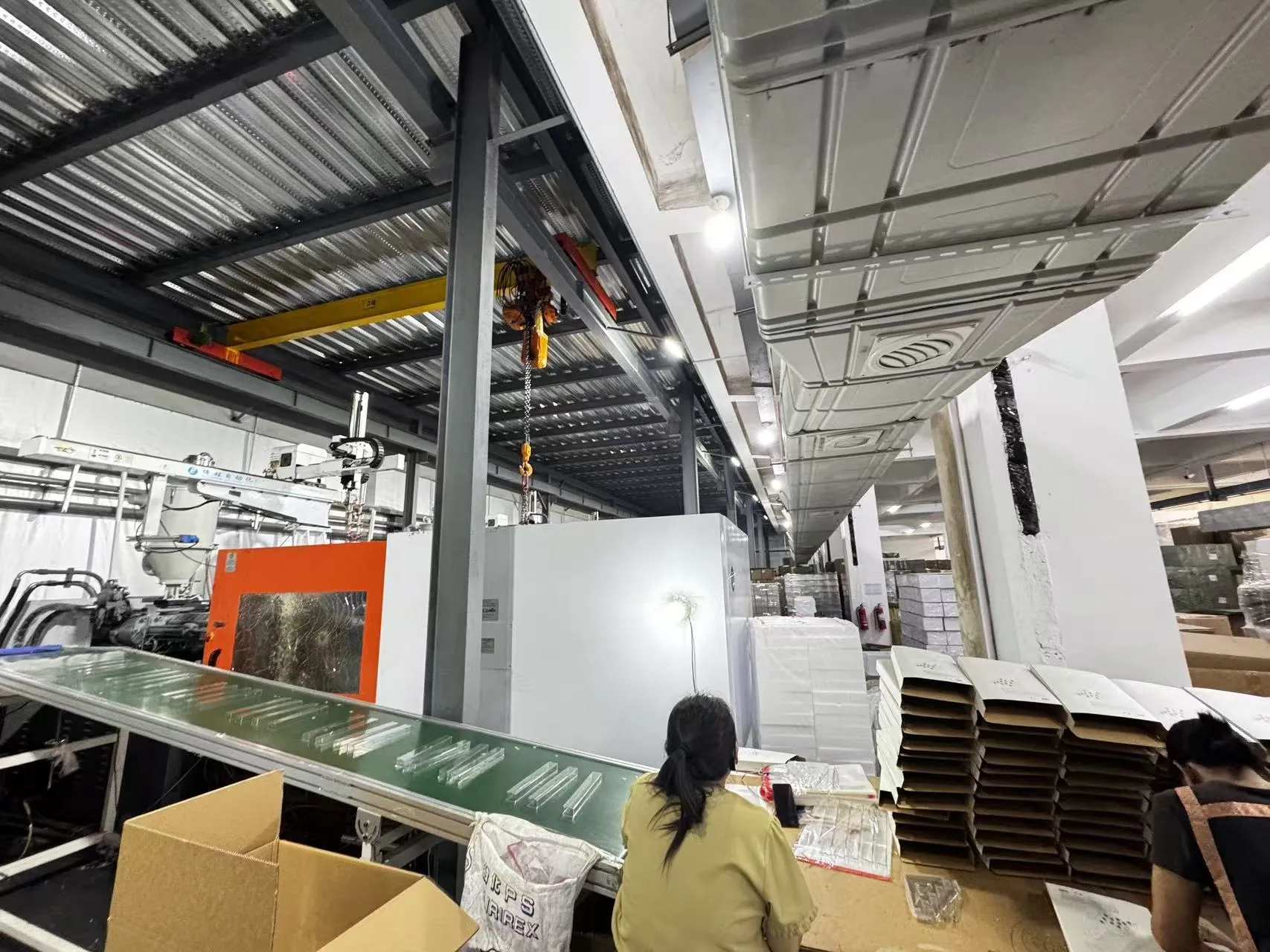
What is the difference between the two routes?
Fabrication starts from standard sheet or rod: it is cut, polished, bonded or mechanically assembled, and each unit carries a share of skilled labour. Molding starts from a machined steel tool: plastic is injected into a cavity and each unit carries almost no labour but a share of the tool. One route scales with labour, the other front-loads cost and then scales cheaply.
Where does the tooling cost sit?
Tooling is a one-off payment that lives outside the unit price, and that is where comparisons go wrong. A molded quote that excludes tooling looks cheaper than it is; a fabricated quote with no tooling line looks more expensive than it is. Any comparison has to add the tool cost across the expected lifetime volume, including the possibility that the design changes and the tool is written off.
How does order size move the decision?
There is no universal quantity at which molding wins. The crossover is where the tool cost divided by the run, plus the molded unit price, falls below the fabricated unit price; because both terms are specific to the cavity, the material and the part size, the answer changes per project. Ask for your design quoted at two or three quantities and compare total cost, rather than applying a rule of thumb from another product. See MOQ, sampling and lead time.
What do you give up in design freedom?
Molding rewards a design that is final. Wall thickness has to be uniform, undercuts need slides, and every change after the tool is cut costs money and time. Fabrication tolerates late change and short runs far better, and it suits low or uncertain volume where committing to a tool would be a guess. If the design is still moving, molding is premature regardless of quantity.
Can one display combine both routes?
Yes, and it is common. A molded base with a fabricated acrylic body, or a molded fitting inside a cut and polished frame, often gives better cost and appearance than either route alone. The practical consequence for a buyer is that a supplier able to run both will tell you which parts belong to which route, instead of quoting everything to the process they happen to own. See custom plastic display stands.
How this buyer content is maintained
Published and reviewed by Yiwu Zhuochao Plastic Products Co., Ltd. Company facts are checked against the assessed Alibaba supplier profile; product and process guidance is based on the supplier’s current manufacturing scope and project-review workflow. Commercial terms and performance statements are published only where the owner can support them. Third-party certification issued by Intertek (天祥集团) is documented on the certification page; unit prices are quoted per project and are not published.
Frequently asked questions
Is molded plastic stronger than fabricated acrylic?
Not in general. Strength depends on material, wall section and geometry rather than on process. Molding allows ribs and compound curves that add stiffness, while fabrication allows a thicker flat section for the same money. Compare the actual part, not the process.
Can an existing mould be moved to another supplier?
Sometimes, but it is not automatic. The tool has to fit the new machine, its condition has to be assessed, and ownership and drawings have to transfer with it. Agree who owns the tool in writing before it is cut, otherwise moving production later becomes a negotiation rather than a decision.
What quantity justifies a mould?
It cannot be answered without the tool cost, the unit-price gap and the expected lifetime volume for that exact design. Request the same specification quoted both ways, including tooling as a separate line, at two or three quantities, and compare total spend across the volume you realistically expect.
Does the minimum order differ between the two routes?
At Zhuochao the minimum order is 50 units across all products. Tooling economics, not the minimum order, is what usually pushes a project toward molding, and a tool commitment is quoted separately from the unit price.