
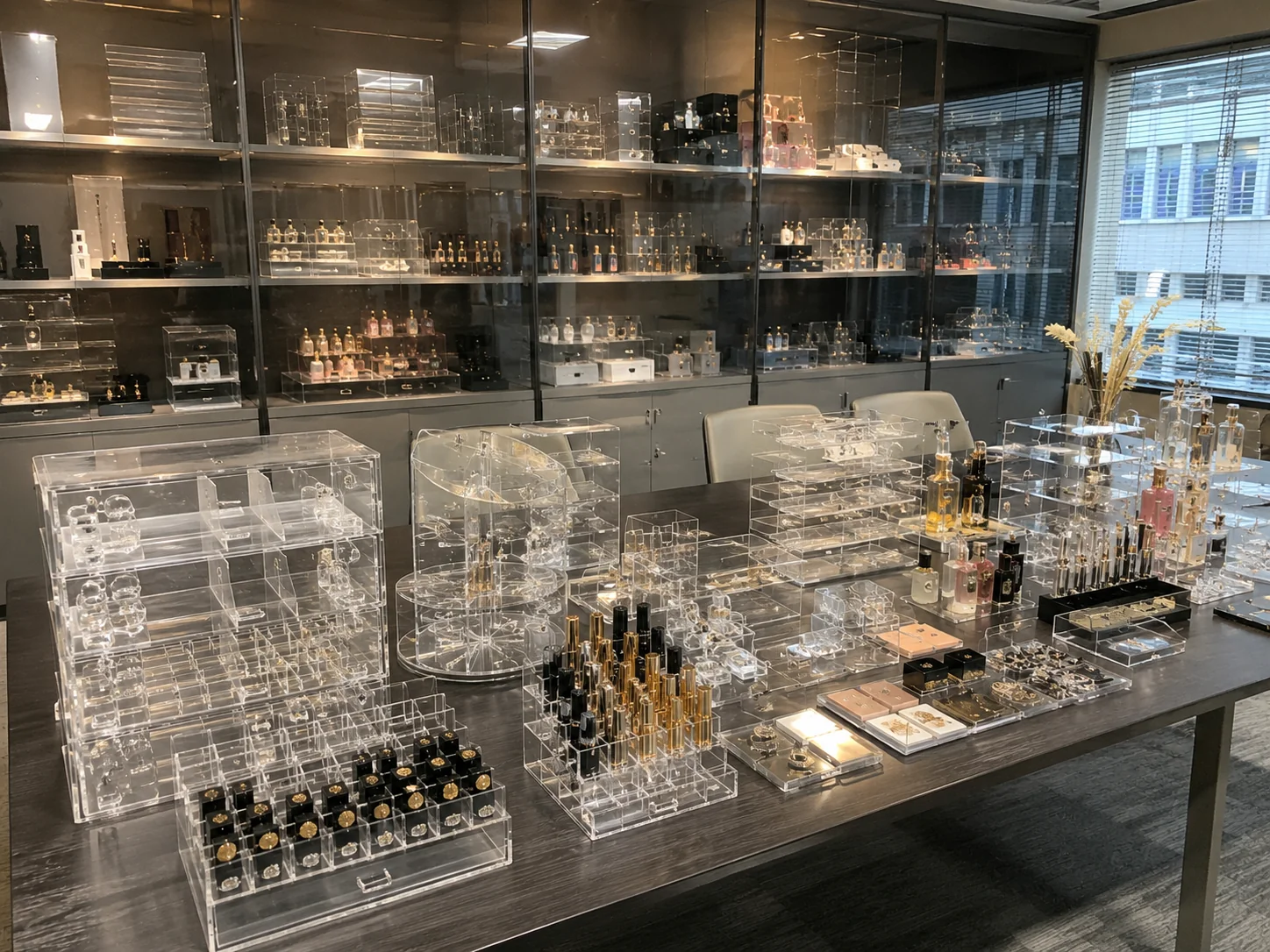
Start from the shelf, not from the unit
The first question is where the display will stand and what the shopper can already see there. A counter in a small cosmetics store is at hand height and holds one decision; a supermarket shelf is read while walking past and has to stop that walk; a floor position has to earn its rent against the fixture next to it. The answer decides footprint, height and how much product the unit can hold before it stops being a display and becomes furniture.
- Measure the available footprint and the height of the fixture above it.
- Note the sightline: counter height, shelf edge height, or floor.
- Decide whether the unit replaces a carton or adds a second location.
Counter display: one decision, within reach
A counter display works when the range is short and the unit has to be handled. It sits close to the shopper, so the top surface matters more than the silhouette, and the unit has to stay stable when a customer takes the front item. Small footprints and low centres of gravity win here; a tall narrow counter unit that tips when the last item is lifted is a design fault, not a customer problem. See custom countertop retail displays.
- Keep the centre of gravity low if the top tier carries the hero product.
- Leave clearance for fingers above the product, not just around it.
- Confirm the counter depth: most retail counters are shallower than they look.
Shelf-ready tray: the carton that becomes the display
A shelf-ready or PDQ tray is designed to be opened and placed in an existing bay, so its dimensions are set by the shelf, not by the product. The value is in reducing handling in the store: the tray arrives loaded, the front is removed, and the shelf is merchandised without unpacking. The constraint is internal height, because the tray has to clear the shelf above once the lid or front is removed.
- Ask for the bay dimensions and the shelf pitch before drawing the tray.
- Design the front removal so it cannot tear a printed panel.
- Check the loaded tray weight against what a store employee will lift.
Floor stand: more space, more obligations
A floor stand buys a second location for the brand and carries far more product, which is why it also carries more obligations: stability under load, a base that survives being kicked, a footprint the store will actually grant, and an assembly that takes minutes rather than an hour. Flat-packed floor stands are common because freight punishes volume, but every joint in a flat-pack is a wobble waiting to happen if the tolerance is loose. See POP display manufacturing.
- Confirm the assembly time the store will accept, in minutes.
- Ask for the load at each shelf, not the total.
- Design the base for a loaded tip test, not for an empty one.
Temporary or permanent: the material follows the campaign
A unit built for a six-week promotion and a unit built to stand for two years should not use the same material or the same joints. Short-life displays tolerate thinner sheet and slot-together construction, because they are dismantled before fatigue matters. Long-life fixtures need thicker sheet, mechanical reinforcement at the joints, and a surface that can be cleaned without clouding.
- State the intended service life in the brief.
- Match the joint type to the life: slots for weeks, bonded or bolted for years.
- Ask how the unit will be cleaned, because cleaning is what wears a print out.
The brief that prevents a redraw
A POP brief that survives contact with production contains the shelf or floor position with measurements, the loaded weight, the service life, the assembly time allowed, the branding method, the packing and shipping assumption, and the quantity. Everything else is a design preference and can be settled later without changing the structure.
- Position, footprint and height available.
- Loaded weight and the weight of the heaviest single item.
- Service life and cleaning method.
- Assembly time allowed in store.
- Branding method, packing assumption and quantity tiers.
How this buyer content is maintained
Published and reviewed by Yiwu Zhuochao Plastic Products Co., Ltd. Company facts are checked against the assessed Alibaba supplier profile; product and process guidance is based on the supplier’s current manufacturing scope and project-review workflow. Commercial terms and performance statements are published only where the owner can support them. Third-party certification issued by Intertek (天祥集团) is documented on the certification page; unit prices are quoted per project and are not published.
Frequently asked questions
Which POP format is cheapest to produce?
Per unit, a shelf-ready tray is usually the cheapest because it uses less material and fewer joints than a floor stand. Total cost depends on the whole chain, though: a cheap tray that needs staff time to load in store can cost more than an assembled counter unit that arrives ready. Compare the landed cost including handling, not the unit price alone.
Can a floor stand be flat-packed and still be stable?
Yes, if the joints are designed for it. Flat-pack stability comes from joint tolerance, interlocking tabs and a base that spreads load, not from thicker sheet alone. Ask for the assembly instructions and a loaded stability check with the drawings, and treat any design that needs tools in store as a decision to be confirmed with the retailer.
How much product should a counter unit hold?
Enough to look full at the end of a trading day, not so much that it reads as stock storage. As a rule, size the unit to the restocking rhythm the store can actually keep: a unit that empties in a day looks broken by the afternoon, and one that never empties stops selling the range behind it.